C#
Used as part of the production implementation for Urban House Properties — Dubai Real Estate Platform.
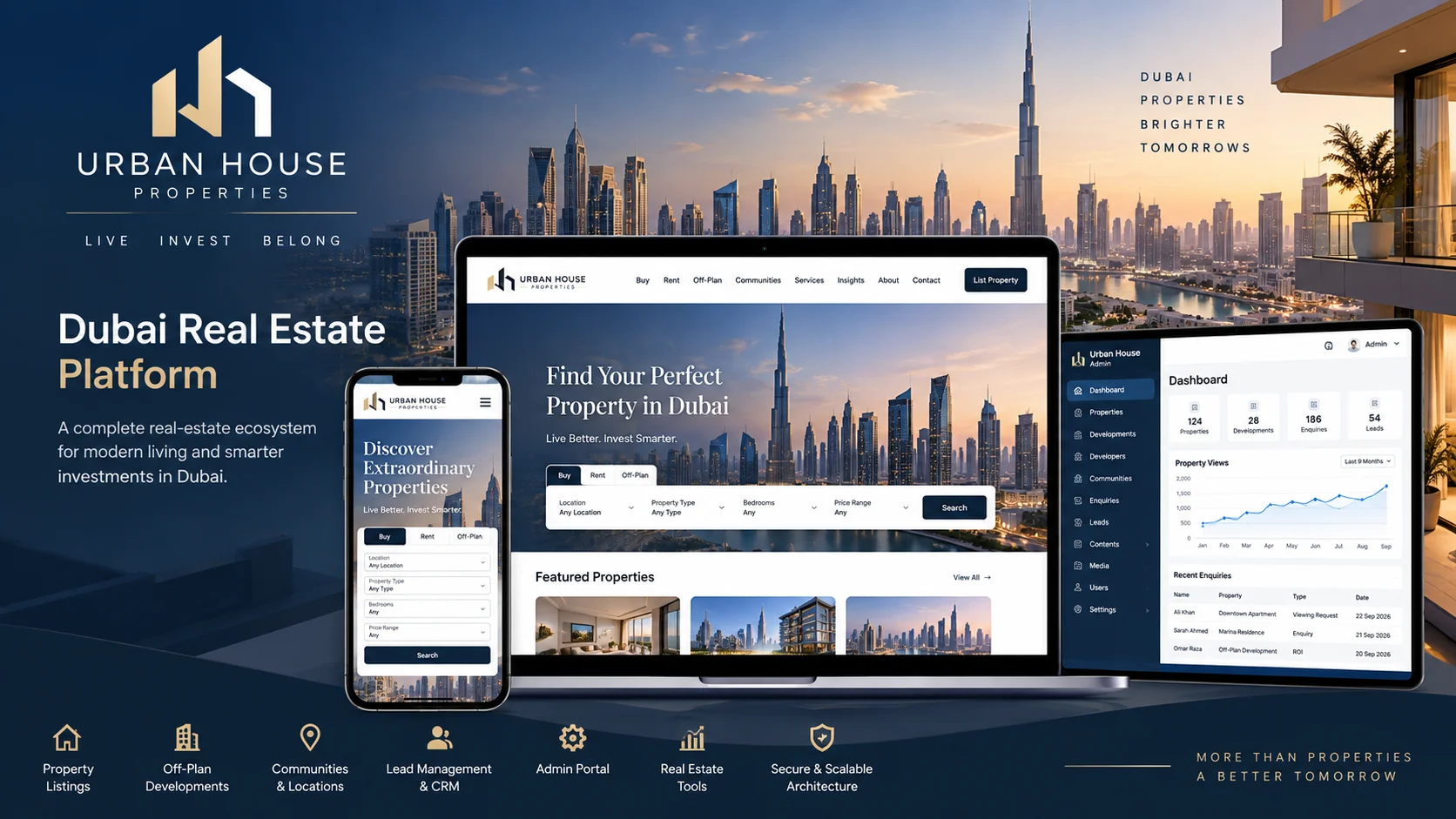
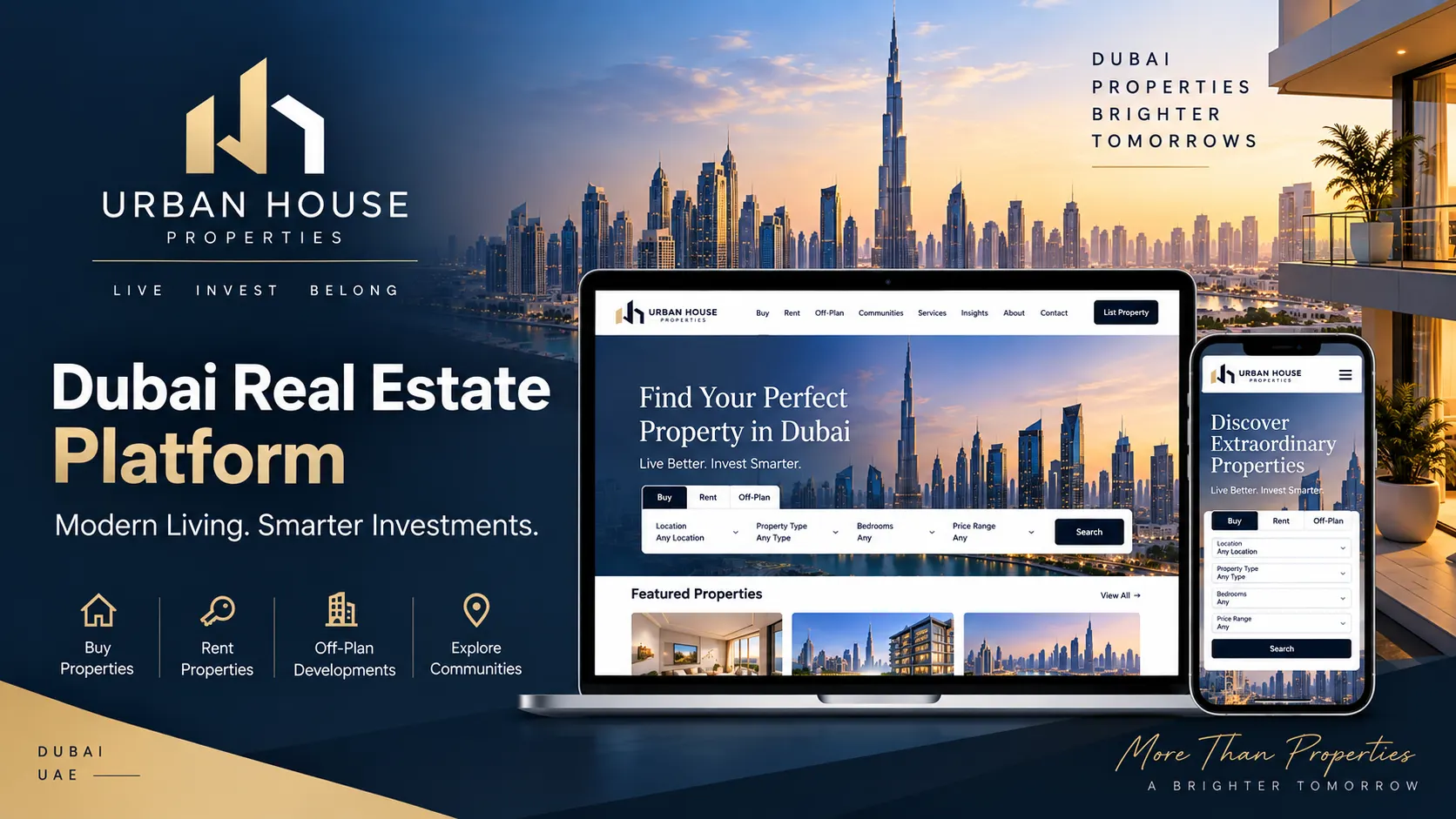
Built a complete full-stack real-estate platform for Urban House Properties in Dubai, including a customer-facing property website, ASP.NET Core REST API, administration system, CRM, property and off-plan management, advanced search, lead capture, Meta Lead Ads integration and production deployment.
Urban House Properties is a complete real-estate web platform developed for a Dubai-based property company.
The project was built as more than a traditional property website. It combines a customer-facing real-estate platform with an administration portal, backend APIs, property and development management, lead-management workflows, content management, enquiry handling, and third-party integrations.
The main objective was to create a centralized platform where the Urban House Properties team could manage its real-estate data internally while automatically making approved content available on the public website.
I independently designed, developed, integrated, tested, and deployed the complete platform.
I worked as the sole developer responsible for the complete technical implementation of the project.
My responsibilities covered the full development lifecycle, including requirements analysis, system architecture, database design, backend development, REST API development, public website development, administration portal development, CRM-related workflows, external integrations, testing, deployment, and production configuration.
Because I handled the project end-to-end, I was responsible not only for writing code but also for deciding how the different parts of the system should work together.
The client needed a professional digital platform for presenting properties, off-plan developments, communities, and real-estate services to customers in Dubai.
At the same time, the business needed an internal system for maintaining this information without manually changing website pages every time a property or development was added or updated.
The platform therefore had to support both sides of the business:
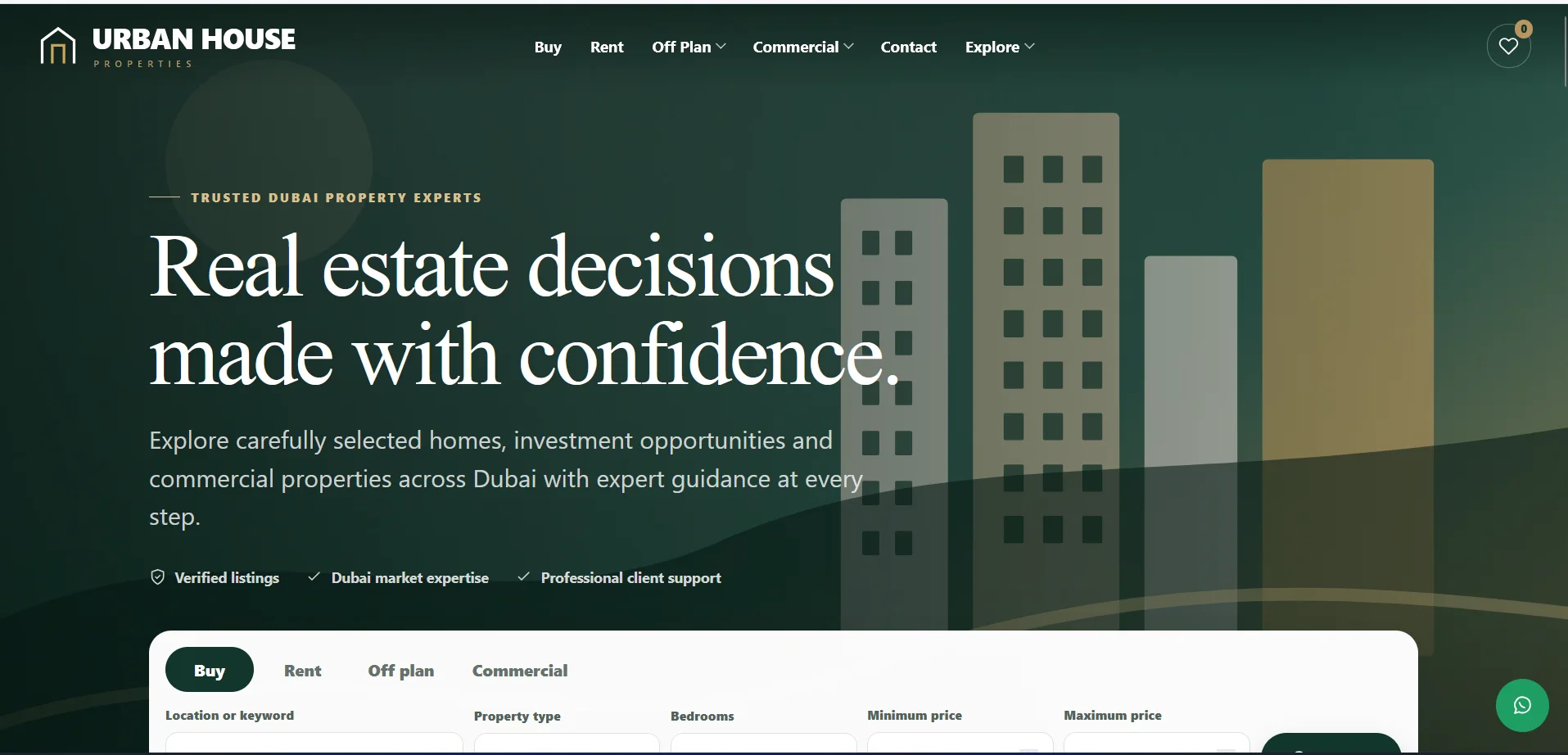
I developed the complete customer-facing website for Urban House Properties.
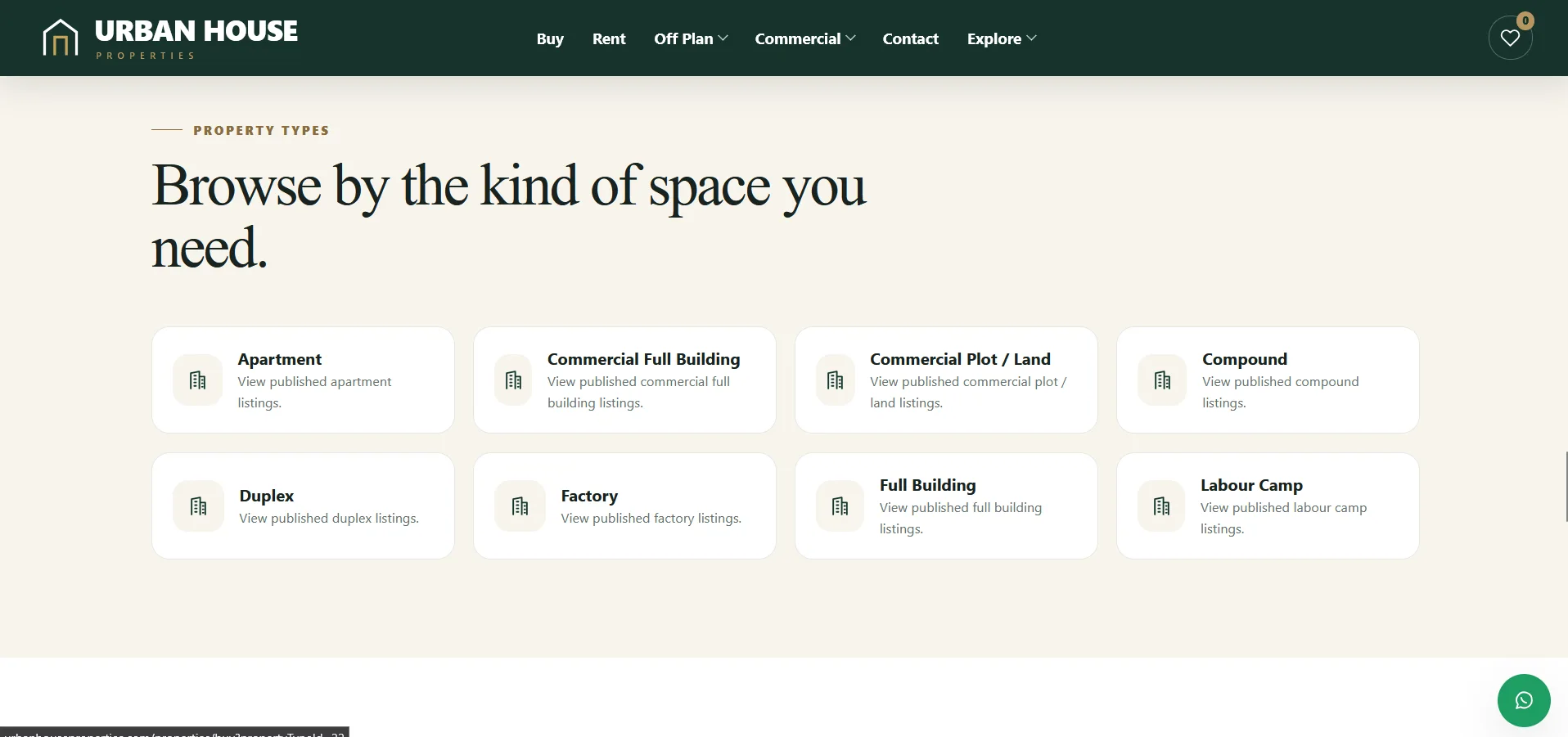
The website allows visitors to explore properties, off-plan developments, communities, real-estate services, market information, and other property-related content.
The public platform is connected to the backend system so that property and development information can be managed centrally instead of being hard-coded into individual website pages.
The interface was designed to provide a modern and professional experience across desktop, tablet, and mobile devices.
A major part of the platform is the property discovery system.
Users can browse available listings and search for properties using multiple criteria such as location, property type, bedrooms, bathrooms, price range, area, furnishing status, and other relevant property information.
The property search system was designed to work with dynamically managed property data rather than static pages.
Results can be organized and displayed in a way that helps visitors quickly find properties relevant to their requirements.
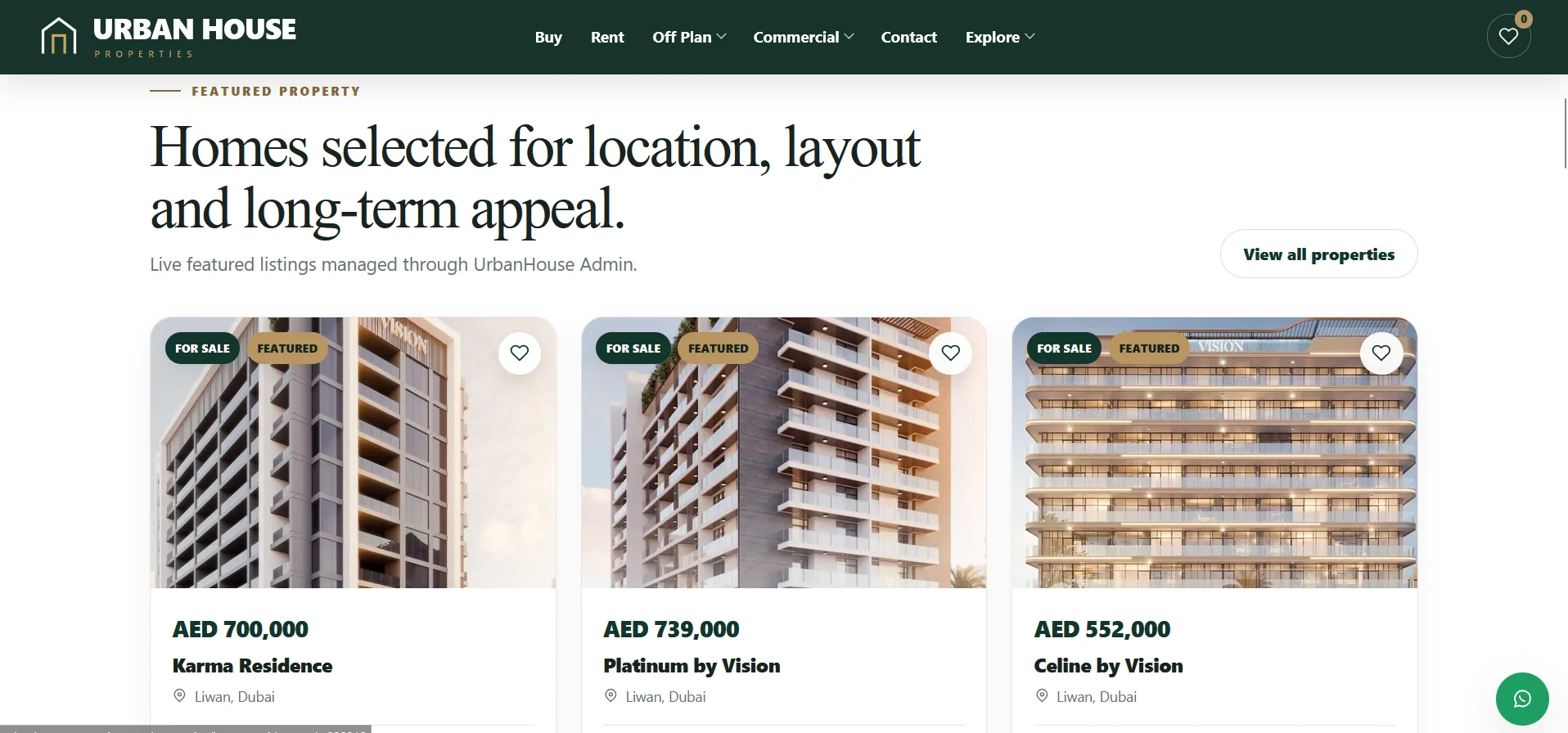
Each property has its own dedicated detail page.
Property pages can display information such as:
Visitors can review the property and directly submit an enquiry or viewing request from the same page.
The system was designed so that property information managed through the backend can automatically appear on the public website.
Properties can contain multiple images that are managed centrally.
The media system allows property images to be associated with individual listings and displayed as galleries on the public website.
This keeps media management separated from the frontend and makes it easier for administrators to maintain property information from one place.
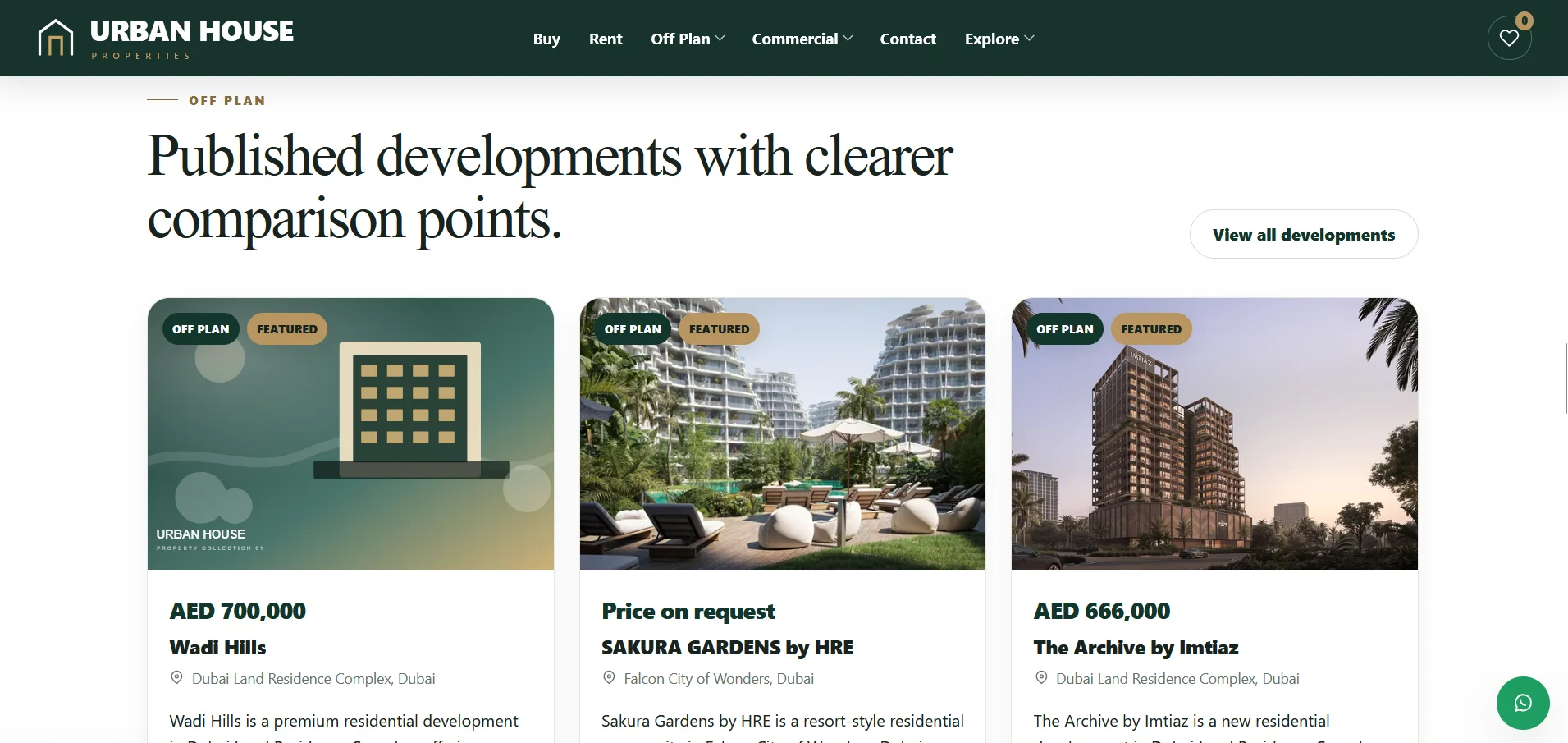
The platform includes dedicated functionality for off-plan real-estate developments.
Developments can contain structured information such as:
This allows Urban House Properties to market off-plan opportunities separately from normal property listings while still managing them through the same platform.
I implemented structured developer and community management so that properties and developments could be associated with the correct real-estate entities.
Developers can be linked with their respective developments, while communities and locations can be used throughout the property system.
This creates a more maintainable data structure and allows the platform to grow as additional developers, communities, projects, and listings are added.
The website includes saved-property functionality that allows visitors to create a shortlist of properties they are interested in.
Users can save listings for later comparison and return to their shortlist without needing to search for the same properties again.
The system retrieves current property information from the backend so saved items remain connected to the latest available listing data.
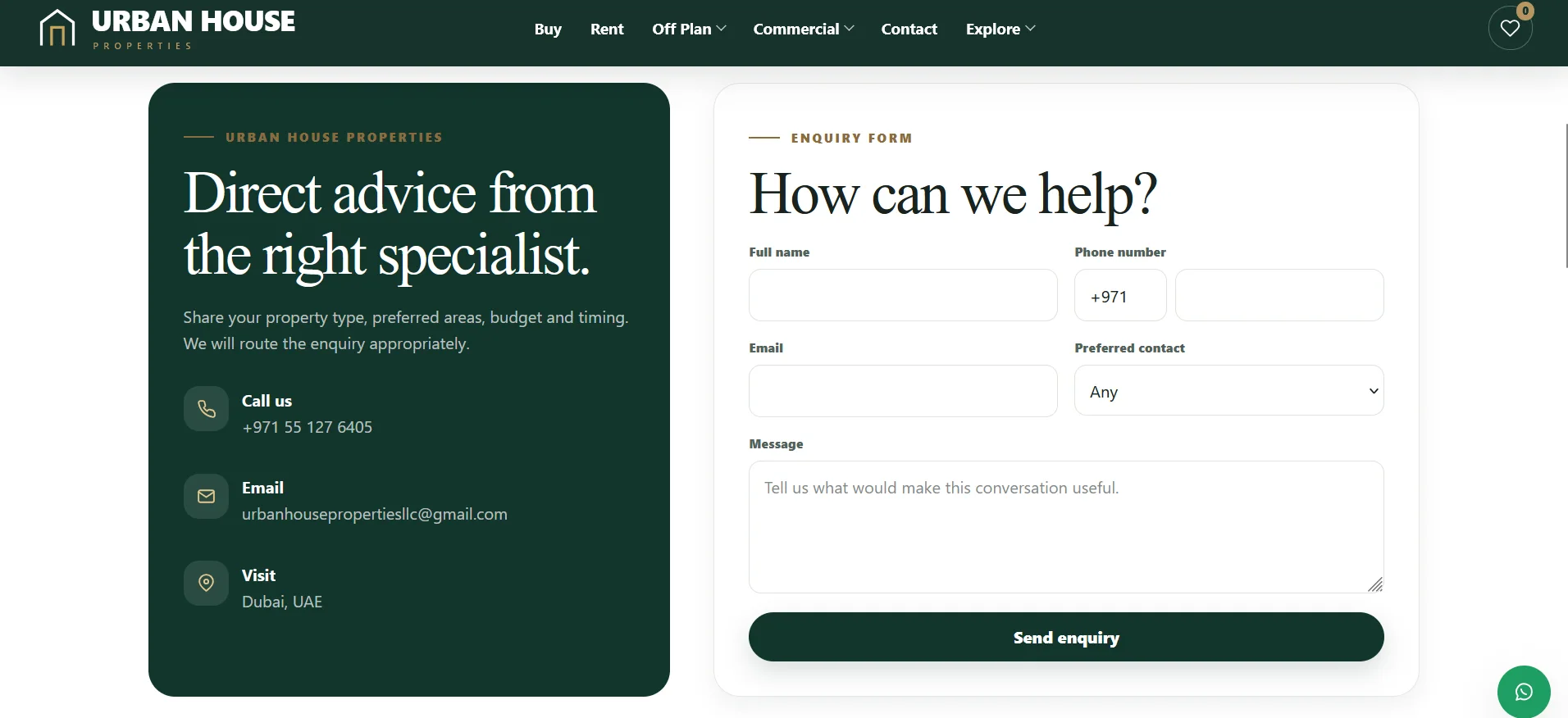
I developed structured enquiry workflows throughout the website.
Visitors can submit enquiries related to individual properties, developments, services, or general real-estate requirements.
Instead of relying only on standard email links, enquiries are processed through the backend so that relevant customer and property information can be captured in a structured format.
This creates a better workflow for follow-up and lead management.
Individual property listings support viewing requests.
A visitor can provide their contact information and preferred viewing details directly from a property page.
The request can then be processed internally by the business rather than being handled as an unstructured message.
This creates a more professional conversion flow between property discovery and customer contact.
The platform also supports property valuation requests.
Property owners can submit information about a property they want to sell or rent, including relevant property details and contact information.
This provides Urban House Properties with another structured source of potential seller and landlord leads.
I implemented multiple contact workflows so visitors can communicate with the business using the method most relevant to them.
The system supports general contact enquiries as well as callback requests where users can provide their preferred contact information and timing.
These requests are processed through the backend rather than existing only as static contact forms.
The public website includes interactive real-estate calculators designed to provide additional value to buyers and investors.
These tools help users perform simplified property-related calculations such as rental yield and buy-versus-rent comparisons.
Adding these tools makes the website more useful than a standard listing portal and gives visitors additional reasons to interact with the platform.
The architecture supports dynamically managed website content.
Instead of storing all website information directly inside Razor pages, relevant content can be maintained through the backend and administration system.
This allows the business to maintain sections such as property information, developments, communities, services, articles, and other content without requiring code changes for every update.
One of the most important parts of the project is the internal Urban House administration system.
I developed the administration portal to give the business centralized control over the data used throughout the platform.
The admin system is designed around real business entities rather than simply acting as a basic website CMS.
It provides a foundation for managing areas such as properties, developments, developers, locations, content, enquiries, leads, media, and other operational information.
The administration system includes dashboard functionality for presenting important information from the platform.
The dashboard architecture allows operational information and key metrics to be presented in one place so administrators can quickly understand activity across the system.
This provides a more practical internal tool than requiring staff to work directly with database records.
The project includes CRM-oriented workflows for handling customer enquiries and marketing leads.
Different lead sources can enter the system while still being managed through a centralized internal workflow.
This allows the business to move beyond simple website contact forms and maintain structured information for potential customers.
I integrated Meta/Facebook Lead Ads with the backend system.
Lead-generation events can be received through a webhook and processed by the backend.
The integration connects the website's internal CRM workflow with leads generated through Meta advertising campaigns.
The overall flow is designed around:
Meta Lead Ad → Webhook → Backend API → Lead Processing → CRM
This reduces the need for manually transferring marketing leads into the internal system.
I developed a dedicated ASP.NET Core REST API that acts as a communication layer between the public website, administration system, database, and external integrations.
The API is responsible for handling public data retrieval and backend operations while keeping application responsibilities properly separated.
The API supports areas such as:
Using a dedicated API architecture also makes the system easier to extend in the future.
The backend was developed using ASP.NET Core and C#.
I structured the application to keep presentation, business logic, data access, and database responsibilities organized.
Dapper is used for controlled and lightweight SQL data access.
The backend was designed to support both the administration system and the customer-facing platform while keeping common business data centralized.
I designed and implemented the SQL Server database used by the platform.
The database structure was created around real-estate relationships rather than simply storing page content.
Core entities include areas such as:
One of the important architectural decisions was keeping these entities properly separated while still allowing them to be related when required.
This provides a stronger foundation for future growth than storing all property-related information in a single table.
The administration system and public website were designed to work from centralized data.
The overall publishing flow follows this concept:
Administration Portal → Backend/API → SQL Server
and
Public Website → Backend/API → SQL Server
This means the business can maintain information internally while the public website retrieves the latest approved information dynamically.
It also reduces duplicated data and makes the platform easier to maintain.
I developed the frontend interfaces for both the public website and administrative workflows.
The public website focuses on property presentation, usability, responsive behavior, and clear conversion paths.
The interface includes components such as property cards, search forms, filtering controls, galleries, enquiry forms, development pages, community sections, calculators, and responsive navigation.
The frontend was built to remain usable across desktop and mobile screen sizes.
The public platform uses server-rendered ASP.NET Core MVC pages.
Dynamic property and development pages can use readable URLs that are suitable for sharing and search-engine indexing.
The architecture allows important real-estate content to be rendered as actual server-side page content instead of depending entirely on client-side JavaScript.
This creates a better foundation for SEO-oriented property and development pages.
Administrative functionality is separated from the public website.
The administration portal requires authenticated access, while public endpoints expose only information intended for website visitors.
This separation helps protect internal management functionality while still allowing the website to retrieve the data it needs.
The project architecture also keeps internal administrative workflows separate from public customer interactions.
I handled the production deployment of the project.
This included preparing the applications for production, configuring environments, setting up the required domains and endpoints, connecting the production database, and resolving deployment-related issues.
The architecture separates the public website, backend services, and administration functionality so that each part can be maintained independently.
One of the main challenges was designing a data model suitable for a real-estate business.
Properties, developments, developers, communities, media, leads, and other entities have different relationships and cannot be treated as a single type of content.
The system needed to remain flexible enough to support current business requirements without creating a database structure that would become difficult to maintain later.
Another challenge was maintaining consistent data between the public website and the administration system.
The public website needed to display current information while the business needed a separate internal interface for maintaining that information.
Lead capture introduced another challenge because enquiries could originate from different areas of the website as well as external marketing platforms.
I solved these challenges by building the platform around a centralized database and backend API architecture.
Business entities were modeled independently and connected through structured relationships.
The administration system became the main management interface, while the API provides controlled access to the underlying data.
The public website consumes the required information from the backend, allowing website content and internal business data to remain synchronized.
Lead sources were also structured so that enquiries from the website and external marketing channels could ultimately be processed through centralized workflows.
The final result is a production-ready real-estate platform rather than a simple marketing website.
Urban House Properties now has a system that supports property discovery, off-plan developments, customer enquiries, property viewing requests, valuation requests, content publishing, administration, CRM-oriented lead management, and external marketing integrations.
The project provides a scalable technical foundation that can continue to support additional properties, developments, communities, users, leads, and future business requirements.
I independently handled the complete development lifecycle of the project.
My contribution included:
The project demonstrates my ability to take a real client requirement from initial planning through architecture, implementation, integration, and production deployment as a complete full-stack solution.
Jul 2026 — Sep 2026
The technology relationships below come directly from the project configuration managed in the portfolio admin.
Used as part of the production implementation for Urban House Properties — Dubai Real Estate Platform.
Used as part of the production implementation for Urban House Properties — Dubai Real Estate Platform.
Used as part of the production implementation for Urban House Properties — Dubai Real Estate Platform.
Used as part of the production implementation for Urban House Properties — Dubai Real Estate Platform.
Used as part of the production implementation for Urban House Properties — Dubai Real Estate Platform.
Used as part of the production implementation for Urban House Properties — Dubai Real Estate Platform.
Used as part of the production implementation for Urban House Properties — Dubai Real Estate Platform.
Used as part of the production implementation for Urban House Properties — Dubai Real Estate Platform.
Used as part of the production implementation for Urban House Properties — Dubai Real Estate Platform.
Used as part of the production implementation for Urban House Properties — Dubai Real Estate Platform.
Used as part of the production implementation for Urban House Properties — Dubai Real Estate Platform.
Used as part of the production implementation for Urban House Properties — Dubai Real Estate Platform.
Used as part of the production implementation for Urban House Properties — Dubai Real Estate Platform.
Used as part of the production implementation for Urban House Properties — Dubai Real Estate Platform.
Used as part of the production implementation for Urban House Properties — Dubai Real Estate Platform.
Used as part of the production implementation for Urban House Properties — Dubai Real Estate Platform.
Used as part of the production implementation for Urban House Properties — Dubai Real Estate Platform.
Media is loaded through the shared entity-media system.
Share the existing system, the blocker, and the expected outcome.